


(And first, huge thanks for being more and more every Tuesdays, thanks for your feedbacks. Please share this letter to anyone building a place, we need more of them)
Aaaahh I’ve been waiting for this one for a long time my friends.
Not because it’s a philosophy or romantic.
Because that’s how it started.
(Oh and quick pause, here is my perfect track to read this letter)
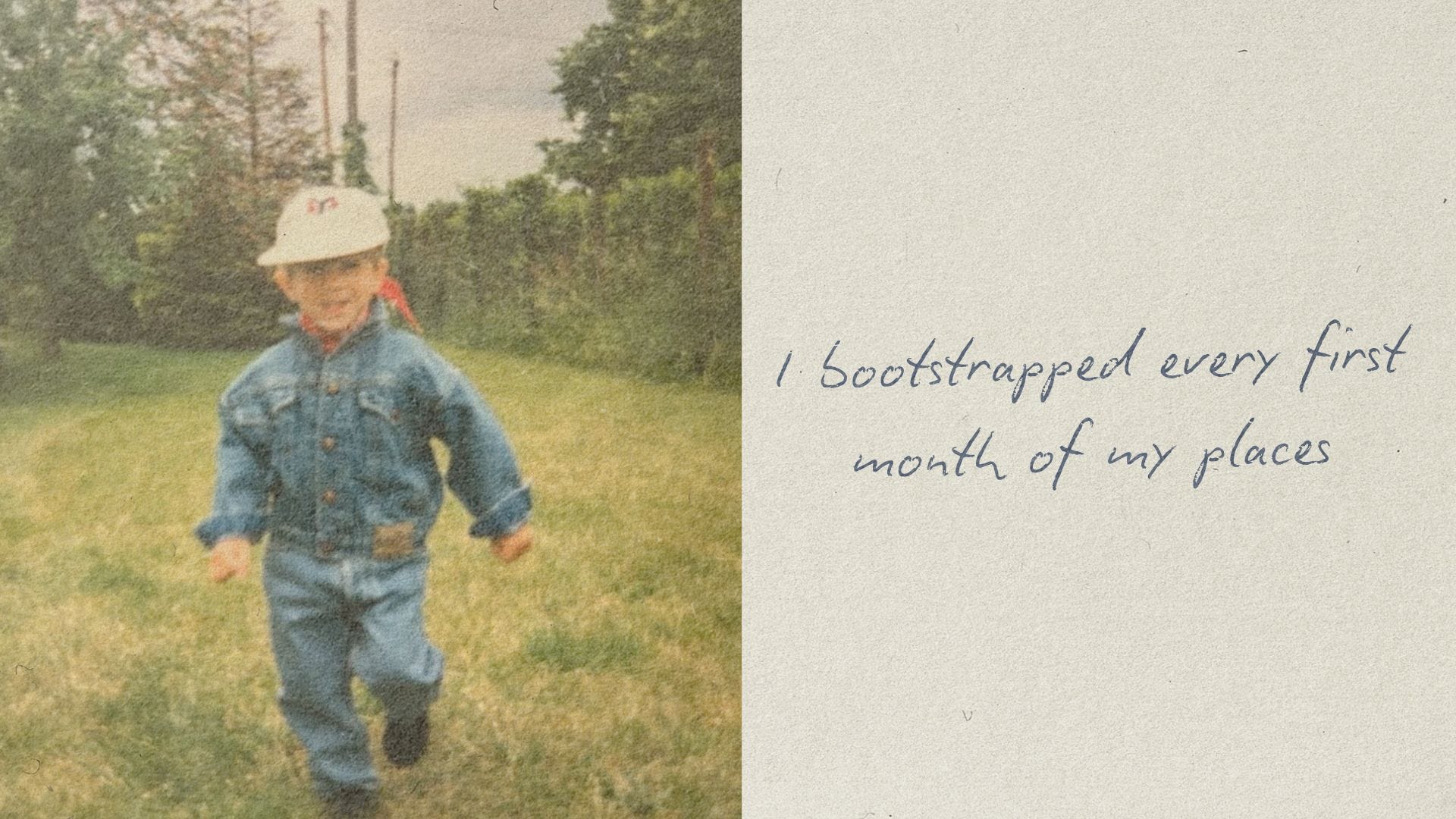
I grew up in a house where everything was made of wood. My dad (Ciao Joel) worked in the wood industry, so wood was everywhere. Planks, offcuts, tools, smells. If you wanted something, you didn’t buy it. You built it.
So that’s what I did.
I built my own skatepark.
Then my first soapbox car.
Later, a music studio.
Looking back, I realize I didn’t just learn how to build things. I learned something more important: when you don’t have, you don’t wait. You assemble. You improvise. You make what you need exist with what’s around you.
That mindset never left me.
I bootstrapped the first months of every place I built the same way. No big cheque. No safety net. Just conviction, a direction, and a lot of decisions made before comfort showed up.
What I learned very early is this: when you don’t have money, the real danger isn’t being small. The danger is looking small.
And young places die from that faster than from a lack of cash.
When you’re starting from scratch, you can’t compete on budget, size, or reach. So you compete on something else. Like signal, your posture and fucking desire. You make your brand behave like a magnet.
Not a logo, or the 10th deck. But like a force field.
I always think about it like a first date (and lets be honest). You don’t explain your constraints (for example I wore a hat, being baldhead…). You don’t list what you can’t do yet. You create a mood. You choose what people see, feel, and imagine. You let them project themselves into the story.
That’s why, very early on, I learned to put the brand on the top floor.
In our first company with Chris, the structure looked bigger than it really was. On paper, five people were managing the company. In reality, it was just us. Customer service emails were answered by Rachel. Rachel was us.
That wasn’t about lying. It was about protecting momentum. Acting like the company we were becoming, not the one we were that morning. Behaving one step ahead of reality. Refusing to let the lack of money shrink the ambition.
And it changed everything.
People didn’t treat us like a fragile project. They treated us like something already in motion. Something worth engaging with. Something that felt alive.
Later, when we started Swenson, the magazine became a turning point.
Not because the brand was impressive.
But because of the people inside it.
By inviting people we admired into the pages, we flattened the hierarchy. Same paper. Same space. Same conversation. Swenson didn’t need to prove its legitimacy. It borrowed it.
The funny thing is that the people we wanted to work with weren’t impressed by the brand itself. They were impressed by the people in the magazine. And by association, the brand stepped into the room with them.
That’s when it really clicked for me.
In the early days, your brand grow by choosing what (and who) it stands next to.
If I had to start a new place tomorrow, with very little money, I wouldn’t obsess over the logo, the website, or the pitch deck. I’d obsess over what surrounds the project.
Who’s around the table.
What stories orbit the place.
What kind of room the brand creates before the doors even open.
Because at the beginning, your place isn’t the destination.
It’s the gravity you manage to create around it.
And that changes everything, much faster than money ever could.
Lets deep dive into practical ideas for your place
When you have no money, perception becomes your capital
Bootstrapping teaches you something brutal very quickly: money doesn’t create momentum. Perception does.
